How a CV joint axle works in modern driveline systems
What a CV joint axle does
A CV joint axle, often called a CV axle or half shaft, is the driveline link between the transmission, transaxle or differential and a driven wheel. It has to carry torque while the suspension moves, and on steerable wheels, while the wheel changes angle. The key distinction from a simple universal-joint shaft is speed control. A constant velocity joint is designed so the output side rotates at the same speed as the input side through its operating angle, reducing the cyclic speed variation associated with many conventional universal joints. In vehicle terms, this helps a front-wheel-drive or independent-suspension layout deliver power smoothly during cornering, acceleration and suspension travel.
For readers comparing drivetrain layouts, the CV joint axle is one part of the broader family of driveline systems, alongside propshafts, differentials, wheel hubs and related joints. Its exact form varies by vehicle platform, but the basic task is consistent: transmit torque while accommodating angle, plunge movement and road-induced motion.
Why constant velocity matters
When a driven wheel changes angle relative to the gearbox or differential, the shaft between them cannot remain perfectly straight. A basic single universal joint can transmit torque through an angle, but unless the driveline is arranged and phased to cancel the variation, it creates speed fluctuation within each revolution. A CV joint is designed to avoid that issue by maintaining near-equal input and output rotational speed through the joint’s working range.
This is especially important in front-wheel-drive vehicles because the front wheels must both steer and drive. During a tight turn, the outer joint works at a significant angle while still carrying torque. The same principle also applies in many all-wheel-drive, rear-wheel-drive and electric-drive layouts with independent suspension, where each driven wheel moves up and down relative to the body and final drive.
Industry literature commonly distinguishes between fixed joints and plunging joints. A fixed joint mainly manages angular movement at the wheel end. A plunging joint also allows the shaft length to change slightly as suspension geometry moves. SAE technical papers and supplier documentation from companies such as GKN Automotive and NTN-SNR describe this fixed-and-plunging arrangement as a standard way to package modern sideshafts.
Main parts of a CV axle assembly
A typical CV axle assembly is more than a metal shaft. It is a compact system of precision contact surfaces, flexible sealing parts and installation hardware. The main elements usually include:
- Outer CV joint: Usually located at the wheel hub side, this joint handles large steering angles and transmits torque to the hub through splines.
- Inner CV joint: Located near the transmission, transaxle or differential, this joint often provides plunge movement to absorb suspension travel and drivetrain movement.
- Interconnecting shaft: The bar between the two joints. It may be solid or tubular depending on design, torque requirement and packaging.
- Boots or gaiters: Flexible covers that retain grease inside the joint and protect the internal surfaces from water, dust and road debris.
- Grease: A dedicated lubricant formulated for high load, oscillating motion and sliding contact inside the joint.
- Clamps, circlips, nuts and splines: Retention and interface hardware that keeps the joint sealed, positioned and properly connected to the hub and drivetrain.
The boot is easy to overlook, but it is often the most important service item. Supplier service guidance from NTN-SNR and SKF emphasizes that the boot’s job is to keep grease in and contaminants out. Once the boot cracks, splits or loses clamp pressure, the joint can lose lubrication and ingest abrasive material quickly.
Rzeppa, tripod and plunging designs
Not every CV joint axle uses the same joint type at both ends. The design is selected around operating angle, plunge travel, torque load, packaging and cost. Three terms appear frequently in driveline discussions.
Rzeppa-type outer joints
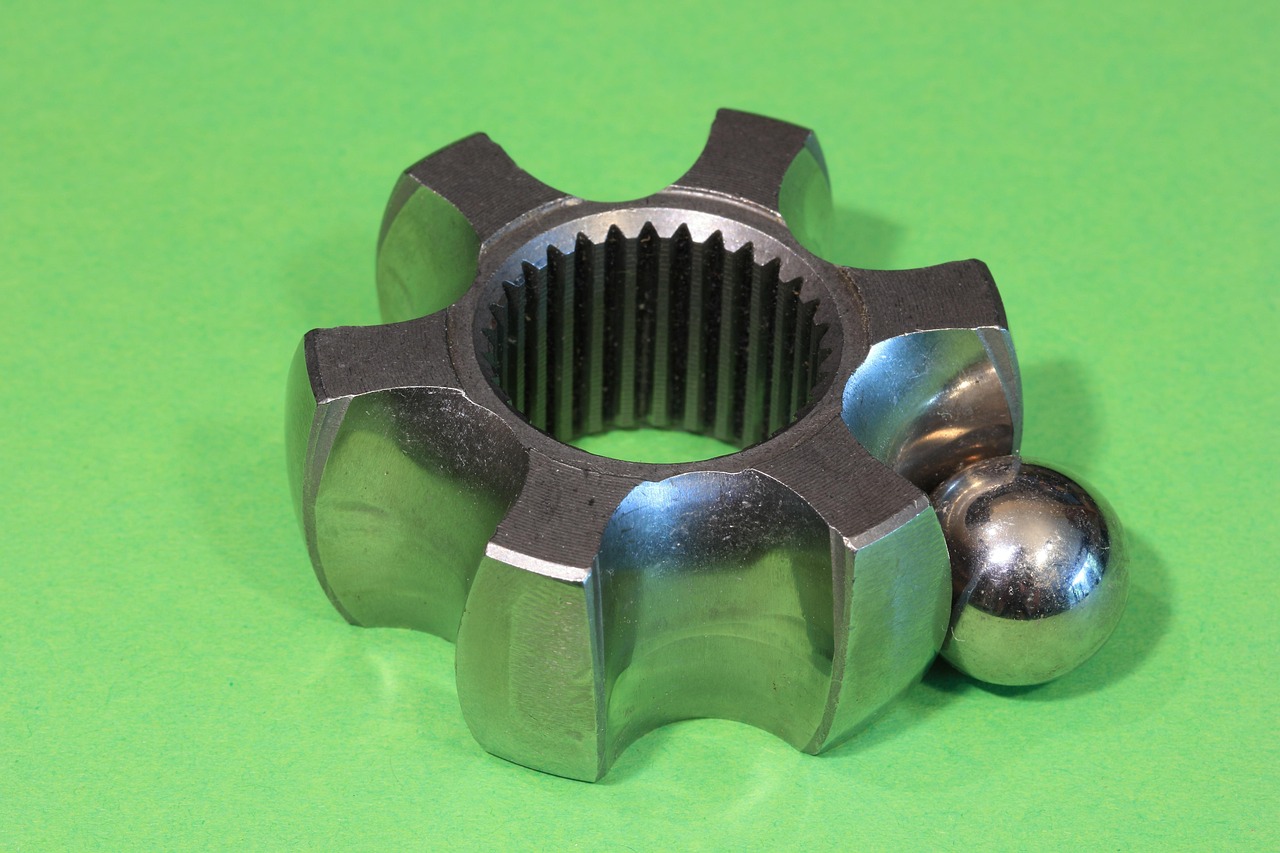
The Rzeppa-style ball joint is widely associated with wheel-side applications. It uses balls running in shaped grooves between inner and outer races, typically controlled by a cage. The design is well suited to smooth torque transfer at higher articulation angles, which is why it is commonly used at the steerable wheel end of a front-wheel-drive axle.
Tripod or tripot inner joints
A tripod joint usually uses three trunnions with rollers that slide in tracks. This design is often used at the inboard side because it can provide plunge movement while managing the changing distance between the transaxle and wheel hub. SAE research on tripod CV joints has examined friction, sliding behavior and operating conditions such as torque, angle and plunge velocity, reflecting how important these factors are to refinement and durability.
Plunging ball joints
Some axle assemblies use plunging ball joints instead of tripod joints, particularly where smoothness, packaging or rear-drive independent-suspension layouts call for them. Supplier literature from GKN Automotive notes that inboard joint choices vary by application, including tripod and ball plunging concepts.
Common symptoms of CV joint axle wear
CV axle symptoms need careful interpretation because tires, wheel bearings, brakes, engine mounts and suspension parts can create similar noises or vibrations. Even so, several patterns are closely associated with CV joint or boot problems.
| Observed symptom | Likely area to inspect | Why it matters |
|---|---|---|
| Clicking or popping during tight turns | Outer CV joint and boot | Often linked to wear in the wheel-side joint, especially if the boot has leaked grease. |
| Vibration or shudder under acceleration | Inner joint, shaft condition and mounting interfaces | Can indicate inner joint wear, shaft imbalance or related driveline issues. |
| Grease around the wheel well, control arm or underbody | Boot, boot clamp and surrounding components | Suggests grease has escaped and contaminants may enter the joint. |
| Clunk during drive engagement or direction changes | Splines, joint clearance, mounts and suspension links | May involve driveline lash or worn mounting points, not only the CV axle. |
| Torn, cracked or deformed boot seen during inspection | Boot and internal joint condition | A damaged boot can lead to rapid wear if the joint is no longer properly lubricated. |
Professional diagnosis usually starts with visual inspection and a road-test pattern, not an immediate parts assumption. If grease is present outside the boot, the technician has to determine whether the joint is still clean and serviceable or whether the contact surfaces have already been damaged. Guidance from suppliers such as NTN-SNR also highlights fatigue, corrosion, impact loading and operation outside manufacturer limits as possible contributors to CV joint degradation.
Inspection and service considerations
CV joint axle service decisions depend on vehicle design, part availability, labor time and the condition of the joint. A boot-only repair may be practical when the damage is found early, the joint has not run dry and there is no contamination or wear. Complete axle or joint replacement is more appropriate when there is noise, vibration, damaged splines, internal wear, severe corrosion or evidence that the joint has operated without grease. See also: braking and chassis.
Several service details have a direct effect on repair life:
- Use the correct grease. CV joints need suitable high-load grease. Mixing unknown grease types or using an unsuitable lubricant can reduce durability.
- Do not over-angle the joint during handling. Supplier fitting guidance warns that excessive deflection can damage boots or internal components.
- Install clamps correctly. Under-tightening can allow grease loss; over-tightening can cut or deform the boot.
- Follow axle nut torque specifications. The hub, bearing and spline interface depend on correct clamping load. Reusing single-use hardware can create risk where the vehicle maker specifies replacement.
- Check related parts. Engine mounts, suspension bushings, wheel bearings and alignment problems can increase noise or vibration and may be mistaken for axle failure.
For repair planning, one practical point is that modern aftermarket axles are often supplied pre-assembled and pre-greased, while some vehicles also support separate joint or boot kits. A complete assembly can reduce bench time and contamination risk, but it is not automatically the right choice in every case. The best decision comes from inspecting the joint, boot, shaft and vehicle-specific installation requirements.
How vehicle design affects CV axle demand
The workload of a CV joint axle is shaped by the vehicle around it. Front-wheel-drive cars place high angular demand on the outer joints because steering and propulsion occur at the same wheels. All-wheel-drive vehicles may use several CV-jointed shafts across front and rear driveline positions. Independent rear suspension often requires half shafts that can articulate as the wheels move vertically. Electric vehicles can introduce high low-speed torque, frequent regenerative torque reversals and packaging changes, although exact CV axle requirements remain platform-specific.
Operating conditions also matter. Large steering angles, aggressive launches, lifted suspension geometry, worn mounts, high torque modifications, impact events and torn boots can all increase stress. That does not mean a CV joint axle is fragile. It means the joint works as part of a system, and its durability depends on angles, lubrication, sealing, material quality and the condition of adjacent components.
Frequently asked questions
Is a CV joint the same as a CV axle?
No. The CV joint is the articulated joint itself, while the CV axle usually refers to the full axle assembly that includes inner and outer CV joints, the shaft, boots, grease and related hardware. In everyday repair language, the terms are often used interchangeably.
Can I drive with a bad CV joint axle?
A vehicle may still move with early CV wear, but continued driving can worsen the damage. Clicking, vibration, grease loss or a torn boot should be inspected promptly. Severe joint or spline failure can prevent torque from reaching the wheel and may immobilize the vehicle.
Which joint usually fails first?
There is no universal rule. Outer joints often produce recognizable clicking during turns because they operate at high steering angles. Inner joints are more often associated with acceleration vibration or shudder. Boot condition, contamination and vehicle use are more important than a fixed failure order.
Should both CV axles be replaced together?
Not always. If only one axle is damaged and the opposite side is quiet, sealed and within specification, replacing both is not automatically necessary. On high-mileage vehicles, or where labor overlap is significant, a technician may recommend inspecting both sides before making the final decision.
What is the most important preventive check?
Regular boot inspection is the simplest and most useful preventive step. A small boot crack or loose clamp can become a major joint problem if grease escapes and dirt or water enters the joint.
Key takeaway
A CV joint axle is a precision driveline component, not just a rotating bar. Its value comes from combining torque transfer, constant velocity motion, steering angle capability, suspension travel and sealed lubrication in a compact assembly. For buyers, technicians and parts professionals, the best evaluation starts with the whole system: joint type, boot condition, grease retention, operating angle, installation practice and the symptoms the vehicle actually shows. That approach helps avoid unnecessary replacement while reducing the chance that a small boot problem becomes a complete axle failure.