Engine braking explained for brake wear, downhill driving and modern vehicles
What engine braking means in everyday driving
Engine braking is the slowing effect created when a vehicle’s engine, motor or drivetrain resists wheel rotation after the driver reduces throttle, selects a lower gear or activates a retarder. In practical terms, it helps control speed without continuous use of the friction brakes, which is why it matters most on long descents and in high-load duty cycles.
Its main value is heat management, not a shorter emergency stopping distance. Service brakes remain the primary system for controlled stops. Engine braking is a supporting method that can reduce brake fade risk and brake wear when it is used correctly. For braking and chassis professionals, the distinction is important: engine braking changes how braking load is shared, but it does not reduce the need for capable pads, rotors, drums, calipers, hydraulic systems, air systems, ABS and stability control.
The term is also used in several ways. In passenger cars, it usually means lifting off the accelerator while the vehicle remains in gear, often in a lower gear. In heavy-duty vehicles, it may refer to an auxiliary engine compression brake, exhaust brake or driveline retarder. In hybrid and electric vehicles, a similar deceleration feel may come from regenerative braking, where the propulsion motor acts as a retarder and returns energy to the battery.
How engine braking works across vehicle types
Gasoline engines and lower gears
In a gasoline engine, closing the throttle limits incoming air. If the vehicle stays in gear, the moving wheels continue to turn the engine through the drivetrain. Pumping losses, internal friction and compression effects resist that motion, creating negative torque at the driven wheels. Selecting a lower gear raises engine speed for the same road speed, so the resisting effect becomes stronger.
That is why drivers feel more deceleration after shifting from a high cruising gear into a lower gear before a hill. The technique is useful when the downshift is matched to road speed. It can become harsh if the selected gear is too low, causing excessive engine speed, driveline shock or unnecessary clutch wear in manual-transmission vehicles.
Diesel engines and auxiliary retarders
Traditional diesel engines do not rely on a throttle plate in the same way as gasoline engines, so their natural closed-throttle braking effect can be weaker. Heavy-duty diesel vehicles therefore often use auxiliary braking devices. FMCSA motorcoach safety guidance describes three common retarder types: exhaust brakes, engine compression brakes and driveline retarders. The same guidance emphasizes that a retarder can slow or help maintain vehicle speed, but it is not a replacement for the service brake system.
An exhaust brake increases restriction in the exhaust stream, making the engine work against back pressure. An engine compression brake, often associated with the common “Jake Brake” name, changes valve operation so compressed air energy is released instead of being returned to the crankshaft. A driveline retarder applies resisting torque through the drivetrain rather than inside the engine. These systems are especially relevant for buses, coaches, trucks and vehicles operating at high gross weights on grades.
Hybrid and electric vehicles
Regenerative braking creates a related but different effect. Instead of converting all kinetic energy into heat at the friction brakes, the traction motor operates as a generator and produces retarding torque. NHTSA interpretations of U.S. brake standards have described regenerative braking systems as using propulsion motors as retarders for partial braking in electric vehicles. That makes regenerative braking important to EV range, brake feel and brake blending strategies.
Regenerative braking is not the same as conventional engine braking. Its available force can depend on battery state of charge, battery temperature, motor limits, inverter capacity and stability-control logic. When regeneration is reduced, the vehicle must rely more heavily on friction brakes. Modern brake-by-wire and blended braking systems are calibrated to manage the transition between regenerative and friction braking as smoothly as possible.
Why it matters for brake wear and heat
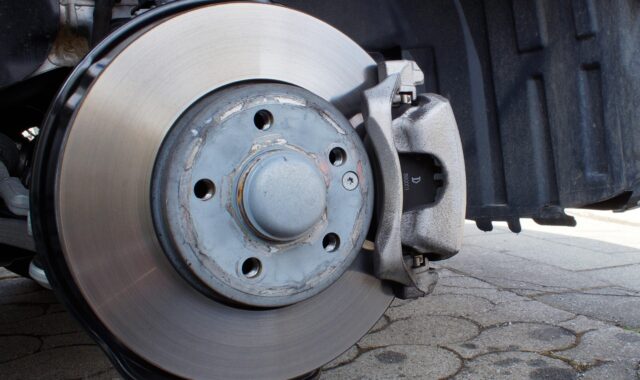
Friction brakes convert kinetic energy into heat at the pads, rotors, shoes and drums. In a short stop, that heat may dissipate without issue. On a long downhill grade, repeated or continuous brake application can raise component temperatures enough to reduce friction stability, increase pedal travel, accelerate lining wear or contribute to brake fade. Engine braking reduces the share of energy handled by the friction brakes, so it can help preserve braking performance over time.
This point matters when selecting parts. Brake pads, rotors and drums are not judged only by how they perform in one cold stop. U.S. NHTSA brake test procedures for standards such as FMVSS 105 and FMVSS 135 include sequences related to fade, recovery, water recovery and partial system failure. Those procedures reflect a basic engineering requirement: a brake system must perform across changing thermal and environmental conditions, not only under ideal workshop conditions.
Engine braking can extend service life in some duty cycles, but it should not be treated as a fix for undersized or poorly maintained brakes. A delivery vehicle in stop-and-go urban traffic, a pickup towing in hilly terrain and a coach descending mountain roads place different demands on the braking system. Brake material, rotor mass, drum design, cooling airflow, caliper condition, wheel bearing health, tire grip and suspension stability all influence the final result.
| Braking method | Where the slowing force comes from | Common use | Main limitation |
|---|---|---|---|
| Conventional engine braking | Engine pumping losses, compression effects and internal friction through the drivetrain | Passenger cars and light trucks on hills or during speed adjustment | Limited force compared with service brakes; may not activate brake lights on many vehicles |
| Engine compression brake | Valve timing changes release compressed air energy in a diesel engine | Heavy trucks, coaches and vocational vehicles | Can be noisy if exhaust and muffling systems are inadequate; may be restricted locally |
| Exhaust brake | Exhaust restriction creates back pressure against the engine | Diesel pickups, trucks and buses | Less powerful than some compression brakes; depends on engine and exhaust design |
| Regenerative braking | Electric motor retarding torque converts vehicle energy into electrical energy | Hybrid and electric vehicles | Can be limited by battery state, temperature and control strategy |
| Service braking | Friction at pads, rotors, shoes or drums, controlled by hydraulic, electric or air systems | Normal stopping, emergency braking and final vehicle hold | Heat buildup and wear if overloaded or poorly maintained |
When engine braking helps most
Long downhill grades
The clearest use case is a long descent. Selecting the proper gear before the downhill section lets the vehicle maintain a controlled speed with less continuous service-brake input. FMCSA commercial-driver material advises drivers to select lower gears for mountain driving and warns that forcing an automatic transmission into a lower gear at high speed can damage the transmission and lead to loss of engine braking effect.
For heavy vehicles, the same principle applies with greater consequence. A loaded coach or truck carries far more kinetic and potential energy than a passenger car. FMCSA guidance for motorcoaches advises reducing speed, placing the vehicle in an appropriate gear, using the retarder and applying service brakes sparingly on descents. The goal is not to avoid the brake pedal altogether. It is to keep the friction brakes from carrying a continuous thermal load.
Towing and payload control
Engine braking is also useful when towing or carrying heavy loads. Extra mass increases downhill acceleration and the amount of energy that must be managed. A lower gear or tow-haul mode can help keep speed from building too quickly. Still, tow vehicles need properly rated brakes, trailer brakes where applicable, correct brake controller adjustment, suitable tires and stable suspension geometry. Engine braking supports those systems; it does not replace them.
Normal traffic speed adjustment
In everyday driving, gentle engine braking can smooth speed changes and reduce unnecessary brake applications. Lifting off the accelerator early when approaching slower traffic allows the vehicle to decelerate progressively. This can improve passenger comfort and reduce pad and rotor temperature spikes. The driver should still use the service brakes whenever following traffic needs a clear signal or when stopping distance must be controlled precisely.
Where engine braking can create risk
Low-traction surfaces
Engine braking and retarders act through the driven wheels. On wet, icy, snowy or loose surfaces, that can create traction problems if the retarding torque exceeds available grip. FMCSA guidance notes that retarders brake the drive axle and cannot detect all slippery-road hazards; it warns that the rear of a motorcoach may lose traction on wet, icy or slippery roads when a retarder is applied. FMCSA driving tips also state that manufacturers generally advise against using retarders on wet or slippery roadway conditions.
This does not mean every mild lift-off event is dangerous. The risk depends on vehicle speed, gear ratio, torque level, tire condition, road friction, load distribution and stability-control calibration. The practical approach is to be smooth, avoid abrupt downshifts and follow the vehicle manufacturer’s instructions for poor weather.
Following traffic and brake lights
Another limitation is communication. Many conventional vehicles do not illuminate brake lights during ordinary engine braking because the brake pedal has not been applied. Some newer vehicles and EVs may activate stop lamps during high-deceleration events, depending on regulation and vehicle logic. Drivers should not assume, however, that following traffic will always receive the same warning as it would during pedal braking. In dense traffic, light and predictable use of the service brake can be safer than relying only on drivetrain deceleration.
Mechanical misuse
Engine braking should be planned, not forced. Abrupt downshifts at high speed can over-rev the engine, shock the driveline, unsettle the chassis or make a manual-transmission clutch absorb unnecessary energy. Automatic transmissions, dual-clutch gearboxes and continuously variable transmissions have their own control limits. The safer approach is to select the appropriate mode early, let the vehicle control system manage allowable ratios and avoid using the gearbox as an emergency brake.
Noise rules and the “no engine brake” sign
Roadside “no engine brake” or “no Jake Brake” signs usually target the noise of heavy-vehicle compression braking, not normal low-gear deceleration in a passenger car. The distinction matters because an engine compression brake can be loud when exhaust and muffling systems are inadequate. State and local rules vary. For example, Washington law addresses heavy vehicles equipped with engine compression brake devices and requires an operational muffler and exhaust system to prevent excess noise. New York City’s noise code restricts compression brake use on certain lower-speed streets except in emergencies.
For fleets, compliance goes beyond driver technique. Exhaust integrity, muffler condition, aftertreatment layout, engine brake calibration and local route restrictions all matter. For parts suppliers and repair shops, complaints about engine braking noise should lead to inspection of exhaust leaks, muffler condition, mounting hardware and any non-compliant bypass or cutout modifications.
What braking and chassis teams should take from it
Engine braking sits between powertrain behavior and chassis control. It affects wheel torque, vehicle pitch, brake temperature, tire slip and driver confidence. In modern vehicles, it may also interact with ABS, traction control, stability control, adaptive cruise control and regenerative braking software. That makes it relevant not only to drivers, but also to engineers, parts distributors, service technicians and fleet maintenance teams.
- Choose brake parts for the duty cycle, not on the assumption that engine braking will always reduce load.
- Inspect friction brakes regularly even on vehicles that use strong regenerative braking or retarders, because low use can still allow corrosion, sticking hardware or uneven surfaces.
- Match downhill driving technique to vehicle weight, road grade, weather and transmission design.
- Follow manufacturer guidance before using engine brakes or retarders on slippery roads.
- Treat noise complaints as exhaust-system and compliance issues, not only as driver-behavior issues.
- Remember that engine braking helps manage heat, while service brakes remain essential for controlled stops.
The most accurate way to view engine braking is as a load-sharing tool. Used early and smoothly, it reduces thermal stress on service brakes and improves speed control on grades. Used abruptly, on low-grip surfaces or as a substitute for maintenance, it can create new risks. The best braking strategy combines sound driving technique with properly specified, inspected and maintained braking and chassis components.
Frequently asked questions
Is engine braking bad for the engine?
Normal engine braking within the manufacturer’s recommended speed range is not inherently bad for the engine. Problems are more likely when a driver selects too low a gear, over-revs the engine or creates harsh driveline shock. Smooth downshifts and proper gear selection are the important safeguards.
Does engine braking wear out the clutch?
Engine braking itself does not automatically wear out the clutch, but poor technique can. Slipping the clutch during aggressive downshifts or using the clutch to absorb a large speed mismatch increases wear. Rev-matched, smooth downshifts reduce that stress.
Does engine braking save brake pads?
It can reduce pad and rotor wear in situations where it replaces repeated light braking or continuous downhill brake application. The effect depends on route, vehicle weight, driver behavior and brake system design. It should be viewed as a way to reduce some heat and wear, not as a reason to delay inspections.
Is regenerative braking the same as engine braking?
No. Both can slow the vehicle without relying only on friction brakes, but regenerative braking uses an electric motor to recover or dissipate kinetic energy. Conventional engine braking uses the internal-combustion engine and drivetrain to create resisting torque.
Should engine braking be used in snow or ice?
Use caution and follow the vehicle manufacturer’s guidance. Strong engine braking or retarder use can apply retarding torque mainly through the driven wheels, which may reduce stability on low-grip surfaces. Smooth speed control and gentle service-brake use are usually safer than abrupt downshifts.