Brake pads and rotors replacement cost and what affects the bill
The short answer on replacement cost
Brake pads and rotors replacement cost is normally quoted by axle, not by individual wheel, because the left and right brakes on the same axle should be serviced together for balanced braking. For a U.S. driver in 2026, a professional pads-and-rotors job can start in the mid-hundreds per axle for a mainstream car and can rise above $900 per axle when higher labor rates, premium parts, dealership pricing or performance brake systems are involved. Published cost references vary because they define the repair differently: AAA lists pads and rotors at about $250 to $500 per axle, RepairPal component estimates updated in September 2026 put brake pads at $335 to $394 and brake rotors at $574 to $698, while Kelley Blue Book reported $548.65 to $629.04 for brake pad and rotor replacement in its March 2025 repair-cost dataset.
The practical point is not to judge a brake quote by one national average. Judge the scope. A fair estimate should state whether it covers the front axle, rear axle or all four wheels; whether rotors are being resurfaced or replaced; what pad material is being used; whether hardware is included; and whether add-ons such as calipers or brake fluid are actually needed.
Why published brake cost estimates differ so much
Brake pricing looks inconsistent because different sources measure different jobs. Some estimates cover pads only. Some include two new rotors on one axle. Some are based on dealership repair-order data, while others model the job using parts and labor assumptions. Taxes, shop supplies, diagnostic time and regional labor rates may also be excluded.
| Published cost reference | Cost signal | How to use it |
|---|---|---|
| AAA consumer repair guidance | Brake pads at about $150 to $350 per axle; pads with rotors at about $250 to $500 per axle | A practical baseline for ordinary repair quotes, especially when the vehicle is a common sedan, crossover or light SUV. |
| RepairPal estimator, updated September 3, 2026 | Brake pad replacement at $335 to $394; brake rotor replacement at $574 to $698 | Useful for seeing how parts and labor can add up, but the estimate excludes taxes, fees and location-specific variation. |
| Kelley Blue Book repair-cost article, March 13, 2025 | Brake pad and rotor replacement at $548.65 to $629.04 | Helpful as a comparison point, but not a universal price because KBB notes that its dataset has its own repair-order scope. |
| ConsumerAffairs 2026 guide citing RepairPal | Brake pads and rotors at $901 to $1,084 per axle | A reminder that estimator-based totals can run much higher when rotors, premium parts or expensive vehicle applications are included. |
The gap between $500 and $1,000 per axle does not automatically mean one number is wrong. One estimate may include aftermarket rotors and modest labor, while another may assume higher-grade parts, dealership labor, a rear electronic parking brake procedure or a vehicle with expensive rotors. The only reliable comparison is an itemized quote for the same vehicle, the same axle and the same parts quality.
What should be included in a brake pads and rotors quote
A clear brake estimate should be specific enough for a driver to compare it with another shop’s quote without guessing. The word brakes is too broad on its own because it can mean pads, rotors, calipers, hoses, fluid, parking-brake hardware or electronic controls.
- Axle and wheel position: The quote should state front, rear or both axles. Front brakes often do more stopping work, but rear brakes can cost more on some vehicles because of parking-brake mechanisms.
- Pad set: The estimate should identify whether the pads are ceramic, semi-metallic, low-metallic or original-equipment style. Ceramic pads often cost more but are commonly chosen for low dust and quiet operation; semi-metallic pads may suit heat and load but can be noisier.
- Rotors: The quote should say whether rotors are new, resurfaced or reused. If new rotors are included, it should list two rotors for one axle.
- Hardware and service items: Quality brake work often includes pad clips, shims, cleaning, slide-pin lubrication where applicable and proper wheel-torque procedure. These small items affect noise control and uneven wear.
- Labor time and rate: AAA has described automotive labor rates as ranging widely by region, with hourly rates commonly influenced by shop overhead and local market conditions.
- Taxes, shop supplies and warranty: A low headline price can rise once fees are added. Warranty length also affects value.
A useful brake quote should also show measurements. Pad thickness in millimeters and rotor thickness compared with the manufacturer minimum are much stronger evidence than a vague warning that the brakes are bad. In more technical brake and chassis discussions, this measurement-based approach is the difference between maintenance and guesswork. For related system context, visit the braking and chassis section.
When rotors really need replacement
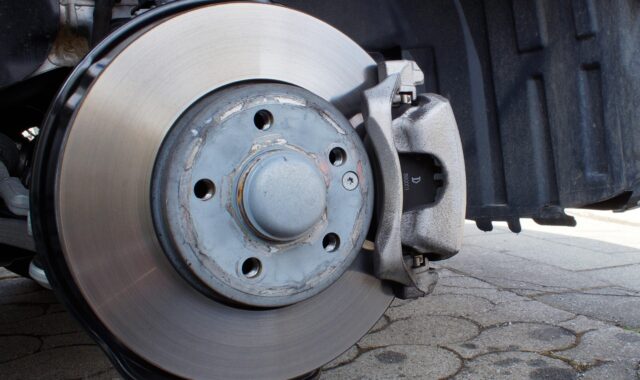
Rotors do not always have to be replaced with pads, but they cannot be ignored. A rotor is the metal disc clamped by the brake pads. If its surface is uneven, grooved, heat-damaged or too thin, new pads may not seat correctly. The driver may then feel vibration, hear noise or experience uneven braking.
Rotor replacement is usually justified when one or more of these conditions is present:
- The rotor is below the vehicle or rotor manufacturer minimum thickness.
- The rotor has deep scoring, cracks, severe rust on the swept area or heat spots.
- The driver feels pulsing through the pedal or steering wheel during braking.
- There is excessive runout or thickness variation after measurement.
- The rotor cannot be machined and still remain above minimum thickness.
- The cost to resurface the rotor is close to the cost of a new rotor.
Resurfacing can lower the bill when the rotor has enough material left and the shop has the right equipment. However, many modern rotors are thinner than older designs, and machining labor can make resurfacing less attractive. That is why some shops recommend new rotors during a pad job. The recommendation should still be backed by inspection results, not treated as automatic for every vehicle.
How vehicle type, parts choice and labor change the bill
The same brake job can cost very different amounts on two vehicles in the same shop. A compact commuter car with plain rotors and widely available aftermarket pads is usually cheaper than a heavy SUV, pickup, luxury sedan or performance model. Larger vehicles often use bigger rotors and pads. Performance vehicles may use specialized rotor materials, multi-piston calipers or brand-specific hardware that can make the parts bill much higher than the labor charge.
Labor is the other major variable. A clean, rust-free front brake job on a common vehicle may be straightforward. A rusty vehicle may take longer because seized rotor screws, corroded caliper brackets or stuck slide pins have to be freed without damaging related parts. Rear brakes can be simple on some models and more complex on others, especially where electronic parking brakes must be retracted with a scan tool or service mode. See also: driveline systems.
Parts quality also changes the invoice. Economy pads and uncoated rotors may reduce the immediate bill, but they may be more likely to create noise, corrosion or shorter service life in harsh climates. Premium coated rotors, original-equipment pads and better hardware can cost more upfront but may make sense for vehicles exposed to road salt, towing, mountain driving or frequent stop-and-go use. The lowest price is not always the lowest ownership cost if the job has to be repeated early.
How to compare estimates without overpaying
A high quote is not automatically dishonest, and a low quote is not automatically a bargain. The goal is to understand exactly what is being sold. Before authorizing brake work, ask the shop to separate the estimate into pads, rotors, hardware, labor, taxes and optional services. If calipers, hoses or brake fluid are added, ask why they are needed now.
- Ask whether the price is per axle or for all four wheels. Many misunderstandings come from comparing a two-wheel quote with a four-wheel quote.
- Ask for pad and rotor measurements. A shop should be able to show pad thickness and rotor condition, especially if the repair is urgent.
- Ask what brand or grade of parts will be installed. Original-equipment, premium aftermarket and economy parts should not be priced as though they are identical.
- Ask whether the calipers are leaking, seized or merely old. Calipers are not normally replaced just because pads and rotors are being replaced.
- Ask whether brake fluid service is due by condition or maintenance schedule. A fluid exchange can be legitimate, but it is a separate service from pads and rotors unless hydraulic work is being performed.
- Get a second estimate when the number is far above published ranges. This is especially sensible if the vehicle is not a luxury or performance model and no additional faults are documented.
For a mainstream vehicle, a pads-and-rotors quote in the $500 to $1,000 per axle zone may be explainable depending on parts and labor. A quote above that range should come with a clear reason, such as specialty rotors, seized components, additional caliper work, dealership-only parts or both axles being included. A quote far below the market should also be checked for missing hardware, reused rotors or unclear warranty terms.
Frequently asked questions
Is $1,000 for brake pads and rotors too much?
It depends on whether the quote is for one axle or all four wheels. Around $1,000 for both axles on a mainstream car may be reasonable in many markets. Around $1,000 for one axle should be supported by premium parts, dealership labor, difficult vehicle design, additional repairs or documented rotor and caliper issues.
Can I replace brake pads without replacing rotors?
Yes, but only when the rotors are above minimum thickness and have an acceptable surface condition. If the rotors are deeply grooved, warped, cracked, heat-damaged or too thin, new pads alone can lead to vibration, noise and faster pad wear.
Do front and rear brakes need to be replaced at the same time?
Not always. Brakes are normally serviced in axle pairs, so both front wheels or both rear wheels are repaired together. Front and rear axles can wear at different rates, so the decision should be based on measurements and symptoms rather than mileage alone.
Why did the shop add calipers to the estimate?
Calipers may be needed if they are leaking, seized, damaged or causing uneven pad wear. They should not be treated as an automatic add-on to every brake pad and rotor job. Ask the shop to explain the failure and show the inspection finding.
Is DIY brake replacement cheaper?
DIY can reduce labor cost, but brakes are a safety-critical system. The job requires proper lifting, correct tools, clean friction surfaces, correct torque, attention to caliper hardware and a safe test procedure. If there is uncertainty about diagnosis or installation, professional service is the safer choice.